
The Graduation Stole I Wear, The Story I Continue
By Tyler Nguyen, LAT 2025 Cohort
For most of my life, April 30th has been a rather unremarkable day. While aware of its significance, marking the end of the war in Vietnam, I rarely have done anything beyond reposting something on Instagram. But this year, I found myself returning to Lansing, Michigan, for the first time since elementary school, in order to commemorate Black April, 50 years after the Fall of Saigon.
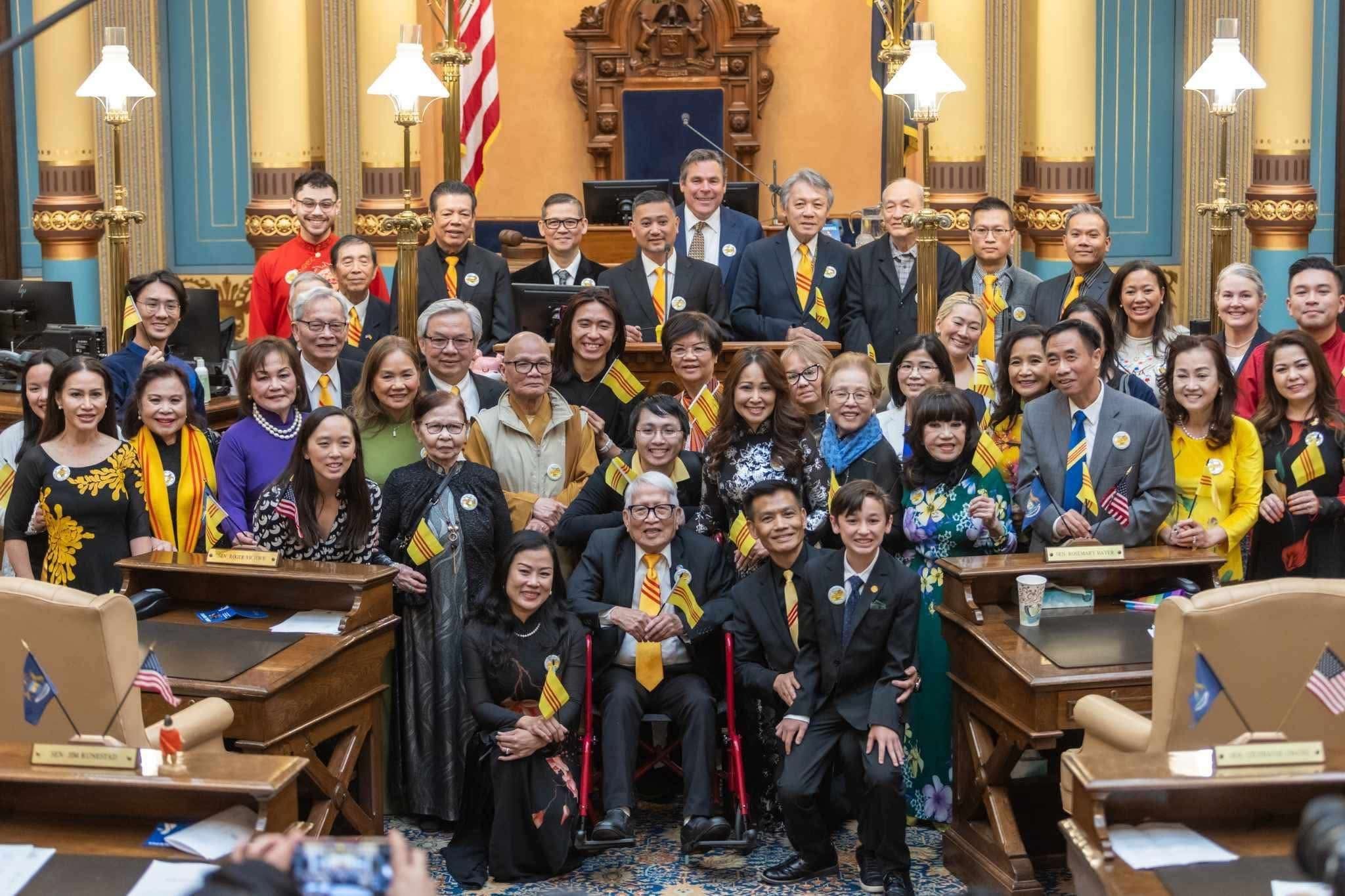
Tyler joined the Vietnamese American Association of Michigan and PIVOT-Michigan in Lansing for a resolution commemorating the 50th Anniversary of the Fall of Saigon. The resolution was sponsored by Michigan State Senators Stephanie Chang and John Damoose. (Photo courtesy of Tyler Nguyen)
On the hour-long car ride, I was fortunate to have a good conversation partner in the form of my mentor and friend, James. I had met him just a few months prior in our state chapter of PIVOT - the Progressive Vietnamese American Organization. A new professor at the University of Michigan’s School of Public Health, James had recently moved to Ann Arbor and graciously offered me a ride to the state capitol. As a student entering my senior year of college, I was eager to learn from his experiences. We talked about our time in Asian American student activism, and I eagerly took notes on his professional path. As we drifted to the topic of Vietnamese student associations (VSA), my attention heightened.
James had noted that some of his students from Vietnam felt unwelcomed by our university VSA, which I was a member of. I had some understanding of this. Our group consisted primarily of second-generation children of refugees, while the international students had their own association. It was an unfortunate divide, and one I had grown more conscious of over the course of college. Still, I knew which group I belonged to.
With my graduation ceremony approaching, I remarked, “At the end of the day, I know what graduation stole I’m going to wear,” referring to a sash adorned with the South Vietnamese flag, a bright yellow banner with three red stripes.
James’ response was quick. “I did that,” he said, “and I kind of regret it.”
With the once-in-a-lifetime event of graduation on the horizon, that did not leave me with much confidence in my decision.
The meaning of the South Vietnamese flag is contentious in the Vietnamese community. It’s primarily claimed by the refugee diaspora and flown in ethnic enclaves from California to Washington, DC. In modern day Vietnam, the flag of South Vietnam is a relic, and sometimes the subject of contempt. There, the flag is a symbol of violence and imperialism. Here in the United States, it’s a symbol of survival and liberation.
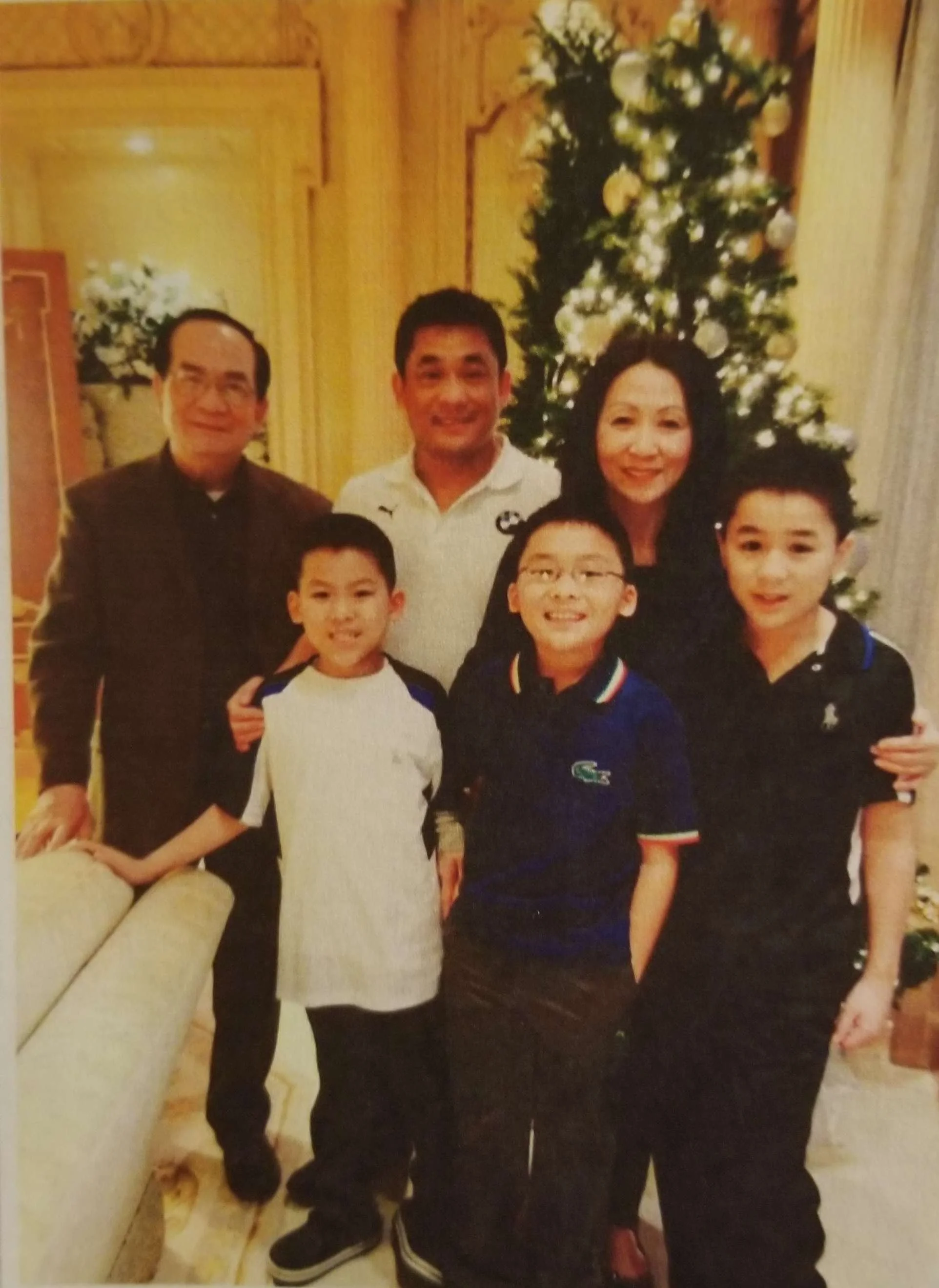
Tyler (center), and his mom, dad, brothers, and maternal grandfather on Christmas vacation. Tyler credits his grandfather as an influence in his work today. (Photo courtesy of Tyler Nguyen)
I have a distinct memory of learning about this difference as a child. I had scribbled a rectangle with a crude star after Googling the “Vietnamese flag,” which I proudly presented to my grandfather. I received a swift correction as he hastily scribbled the southern banner in pencil. Since then, I’ve kept the stripes in my heart, and the star out of my Instagram bio.
Yet, this view has become complicated in recent years. As I’ve grown in my Asian American identity, I’ve struggled to reconcile my understanding of America with the violence of US imperialism. Our nation’s colonization of the Philippines laid the foundation for massacres in Vietnam, Laos, and Cambodia, characterized by bombings that killed “allies” and “enemies” alike. Today, I am admittedly proud of Vietnam’s rise, prevailing as a regional economic leader out of the ashes of war. As I’ve learned more about the country of my ancestors, I’ve come to admire the centuries of resistance against foreign invaders to safeguard our heritage and identity.
The United States has certainly not proven to be a perfect refuge. Our country continues to deport countless Southeast Asian refugees, many of whom are removed on the grounds of decades old convictions. Despite the popular narrative of a prosperous and successful resettlement, countless families, including mine, have not had a particularly easy time “settling.” Our communities, just like anyone else, are pained by the rising costs of food, housing, and healthcare, and fear the racial animosity that comes with each wave of East versus West sensationalism.
And yet, I find myself stubbornly attached to both the South Vietnamese flag, and the United States as a whole.
To some degree, I think it’s because it reflects my reality a little better. The South Vietnamese flag is the emblem of choice for refugees who live here. I was born in the US, have never set foot in Vietnam, and my parents haven’t returned in two decades. My Vietnamese language skills are basically nonexistent, far worse than even my second-generation peers. Ironically, I’m fascinated by Americana, adoring the sounds of jazz and the heroic exploits of Captain America and Superman. While admittedly a bit silly, these interests have deeply informed my own identity.
More importantly, I claim the flag because of the story I want to continue. My parents aren’t particularly nationalistic, but they’d have a hard time claiming Vietnam’s national flag. After the American War in Vietnam, my grandfather was put in a re-education camp, and both sides of my family hastily fled violence and persecution. Upon arriving here, my parents worked tirelessly so I could have a better life in America. That’s not a narrative I accept uncritically, but one that is nonetheless true. My parents also were the ones who taught me to value freedom, justice, and life; the underpinnings of “The American Dream.” Though that idea has been complicated over the years, it’s one that I hold onto tightly.
I’m a Vietnamese-American activist, critical of the United States and its cruelties. Yet, that same identity, rooted in my family, community, and our stories, motivates me to be optimistic about where my country will go. After I graduate in the spring, I hope to enter a career in public service, trying — perhaps foolishly — to help build a nation that serves all people. I’m happy to say that now, after a few months of reflection, I know what graduation stole I’m going to wear.
Tyler Nguyen is a Vietnamese-American Michigander and student at the University of Michigan. He is a budding organizer with a passion for working with Asian American, immigrant, and refugee communities. Currently, Tyler is interning at Rising Voices, a nonprofit dedicated to organizing Asian American women and young people for progressive values, and helps mobilize campus communities as a student activist. He previously participated in LAT 2025 under the Immigration Cohort, advocating for an end to third country deportations and advancing the Southeast Asian Deportation Relief Act (SEADRA).